

Introduction
Education is an essential pillar on which the future of every child stands. No wonder why every sane government, irrespective of the nation, invests in the education of its children. The outcome of education is not just the acquisition of a particular degree, but also the development of a person beyond that. How one learns to deal with daily problems, to balance life with work and relationships, and to be a contributor to society. Education instills in a person civic consciousness, compassion, and toughness, and then they are able to do more than simply obtain a job. To live with dignity and meaning in the world that is constantly changing.
Nonetheless, such a form of education is still a distant dream for many families in India. This is not due to the lack of policies, but the failure and discontinuation of their proper implementation. The authorities have made some progress towards the goal of a fully literate India. But the obstacles are still there. The problems are often linked to poverty, gender, and location.
Challenges to Accessible Education
Economic and Infrastructure Barriers to Schooling
Firstly, the drop out rates amongst children is alarmingly high. As per reports around 35-40% of India’s literate adults had dropped out of school after primary education. This happens because free primary education in India is a fundamental right. Moving on to secondary education, costs increase such as that of uniforms, books, transport, and opportunity costs. Many parents feel the need to increase household income after basic education, so they push their children into work at a young age. Other reasons are lack of hygiene facilities, far-off schools, and bad school buildings.
Besides, even though there has been an increase in the enrollment of students in the past few years, the standard of education has not changed. Very poor essential skills in reading, writing, and arithmetic are still very much prevalent. Besides, the curriculum is unable to keep up with the modern skill requirements. Such as critical thinking, problem solving, emotional intelligence and digital literacy.
Gender Inequality and the Girl Child’s Education
On the other hand, the situation of the girl child is still quite poor. Women illiteracy rates in 2020 are almost the same as those of Indian men in the 1980s. Families still prioritize sons to attain education, usually putting their girl child to fulfill domestic roles. In rural and economically weaker sections, early marriage remains a major deterrent to girls completing their education. Moreover, safety concerns, lack of menstrual hygiene facilities, and hesitation from the child’s side to attend school after menarche further compound the issue, pushing many girls out of the classroom.
The impact of education on girls is enormous. Women with education will be the ones that will take care of their children by giving them the best health, and education. Thus one positive uplift will go on through the generations. When society denies girls the opportunity to study, it loses half of its potential human capital.
The Stress-Free Learning’s Importance
The education being stress free learning is the question that waits when the hurdles are crossed. Nowadays, grades are taken as a measure of success which, gives rise to huge academic pressure on the students. In this regard, one’s grade is compared to the others like siblings, friends, or class-mates which makes the situation more difficult. Hence unhealthy competition is created instead of learning that is stimulated. Each kid has his or her learning pace with their own strengths, interests, and weaknesses. The competition from parents and teachers to outshine others is the least that the kids need at such a young age.
In most Indian families, people rarely talk about mental health, and they often ignore or misunderstand stress, anxiety, and emotional struggles. The situation is much more concerning in rural and low income households where such thing as a child mental health is not even heard of. Even if a child has anxiety or stress, they will not be able to identify it and seek timely help.
It is the responsibility of government institutions, communities, and families to ensure that a child gets a childhood they deserve, one that is safe, and supportive.
Stepping in of NGOs
NGOs play a crucial role in filling the gaps of the education system as well as taking care of each child’s emotional and mental well being in their organisation and enrolled in their programmes. They carry out impactful work by connecting with underprivileged communities that society has long overlooked and unrecognized. Gradually building up their trust, enrolling little ones into schooling, imparting skilled trades, and showing them the right path to their future. The NGO for child education kindly and tactfully heal the society by allowing children to be in learning spaces where the children feel respected, listened, and empowered.
Akshar Kaksha for Children at Prazna Foundation
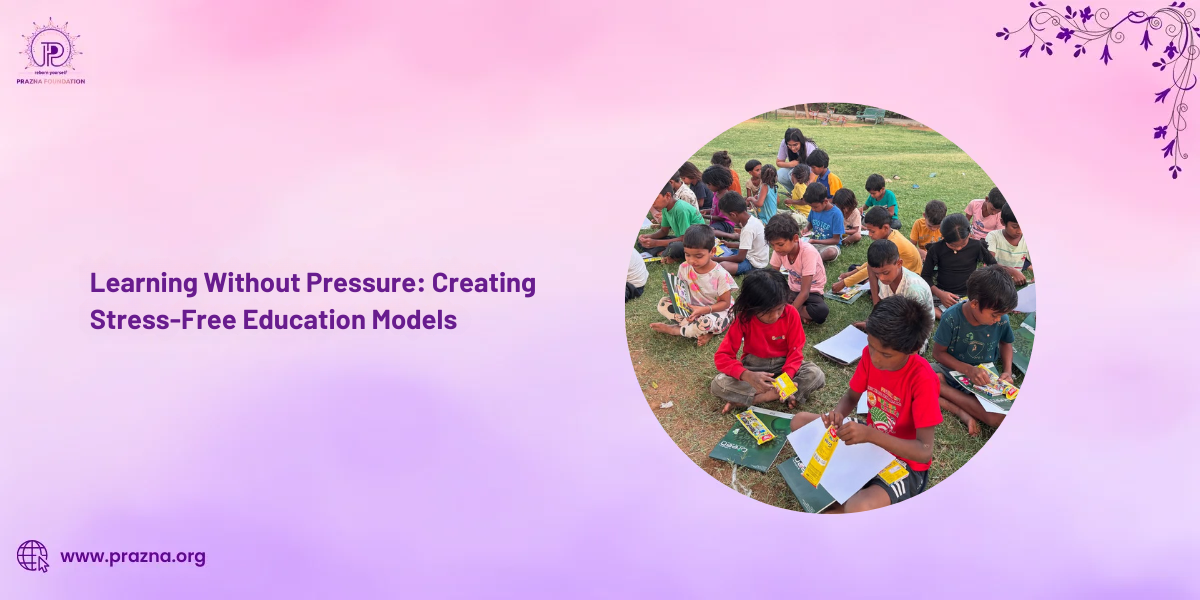
Prazna Foundation feels that children from poor families must have equal opportunities to education and that learning should be an enjoyable and empowering process for them. We make it through our campaign, Akshar Kaksha for children that a child can be safely, inclusively, and unstressedly educated. Encouraging children to be inquisitive, free, and grow at each child’s own pace rather than hurried attainment
Our efforts go beyond just teaching. We are aware that a complete education considers the whole child’s wellness. Through our programs, we have a continuous interaction with girls. They are becoming aware of menstruation and the women’s bodily function, what is personal hygiene, etc. Periods, and personal hygiene are no longer women’s taboo subjects. The children and their parents who have been through proper nutrition education. They not only know what is a balanced diet but also why it is so important for physical growth, mental development, and overall well-being.
Conclusion
To provide a child with a quality education is a necessity not a choice. But for the child to learn, it has to come with love and care. Be it mental health therapy or proper nutrition, Akshar Kaksha concentrates on the whole child development. Our work goes beyond merely addressing the academic deficiencies, we contribute to the development of the children as self-assured, wholesome, and fully-developed individuals.


