hails from Gokul, a holy town in the state of Uttar Pradesh. She is a social
Prazna > Blog > Why Are Millions of Girls Still Missing School During Their Periods?
Why Are Millions of Girls Still Missing School During Their Periods?
Introduction
If periods are a natural part of life, many girls end up dealing with a stack of hurdles like not enough awareness, trouble getting sanitary products, rough sanitation facilities, and social stigma that just doesn’t go away. These blocks don’t only mess with education; they also pull down confidence, influence health, and limit future chances.
Organizations like the Prazna Foundation are trying to push for real, long-term shifts by passing along simple knowledge, nudging daily habits that are healthier and more grounded, and giving adolescent girls a bit more agency through programs like Project Kishori.
Why Do Girls Miss School During Their Periods?
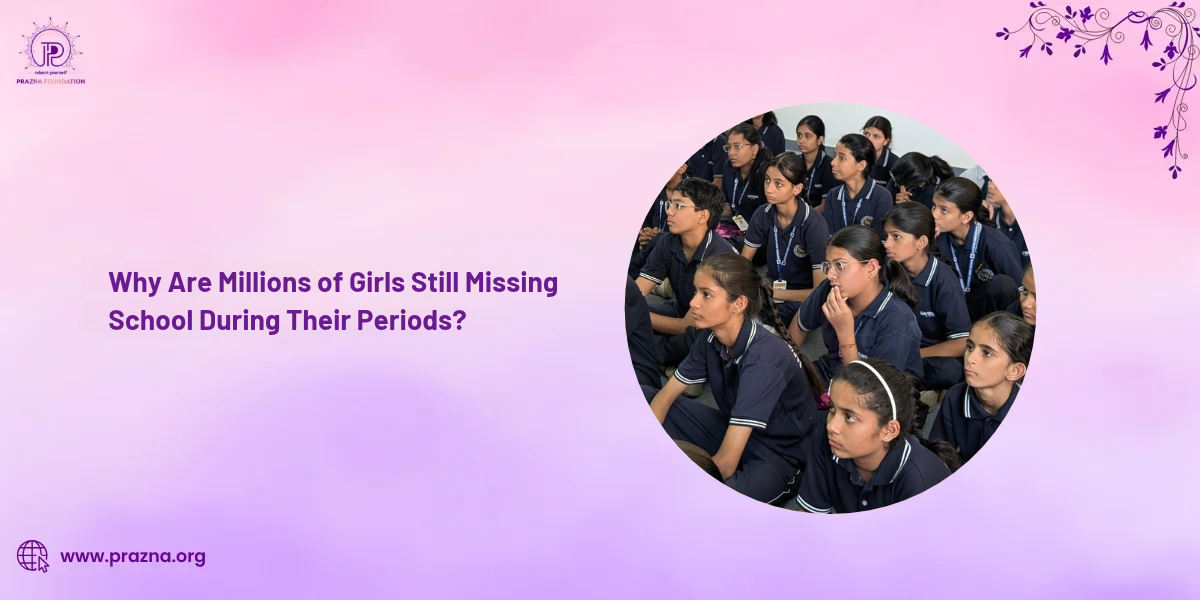
A lot of girls end up skipping school because they don’t really have access to clean menstrual materials, or they just don’t have decent private washrooms. And also, the chance of getting what they need quietly, well, it just isn’t there. In a few communities, menstruation is still treated like this taboo thing, you know, so girls end up feeling awkward, quietly embarrassed, when they need to ask for help in the first place, like they’re doing something wrong, instead of it being a normal, bodily process.
The Impact of Poor Menstrual Hygiene When menstrual hygiene is poor, it can really trigger infections, make things feel more uncomfortable, stir up anxiety, and lower self-confidence too, because you can actually feel it building up, day by day. And when girls keep skipping classes again and again, every month without fail, they may start to struggle to catch up with what’s being taught, since it slips by unnoticed, one cycle after another. That catching-up part rarely truly happens, and over time, it can begin to raise the chances of dropping out.
So this is why women’s health and hygiene really needs to be treated like a priority in schools and communities. Besides teaching, having access to clean toilets, water that is safe enough, and sanitary materials that are secure helps create a setting where girls can keep studying without those constant interruptions Breaking the Stigma Around Menstruation One of the biggest obstacles is the silence around periods, and it’s kinda strange really how that just hangs there, like nobody wants to touch it. Many girls grow up without getting accurate information before their first menstrual cycle, so in the end fear and confusion become these things they just have to live with for a while, even if nobody really explains it properly or even attempts to. Strengthening menstrual hygiene awareness education really helps, because it nudges open conversations between parents, teachers, healthcare workers, and students too. When menstruation is talked about as a normal biological process, not like a hidden secret, girls often feel more assured, and they are less likely to miss school for simple reasons that make sense, even if it’s a little awkward at first. The Importance of Community Support
Schools alone cannot do everything for this problem. It takes families, local communities, healthcare professionals, and social organizations too; they all matter a lot when it comes to promoting menstrual health, and honestly, it does not work if only one side tries. As an NGO for Women, Prazna Foundation works with communities so they can spread awareness, teach adolescent girls, and help build good menstrual habits. With Project Kishori, the organization reaches young girls and shares practical know-how around menstrual hygiene, nutrition, personal health, and emotional well-being; it’s also mostly hands-on and somehow surprisingly easy to put into practice, even when people think it will be complicated
How Menstrual Hygiene Awareness Creates Change
Teaching girls about menstrual health can create payoffs that last longer than just staying in school. It helps grow self-confidence; it’s also about keeping physical safety steadier, and, a bit more quietly, it widens fairer possibilities in education. Starting a Menstrual Hygiene Awareness campaign might seem little at first, but it helps schools get cleaner sanitation systems in place, and it also nudges the wider community to replace those old myths with more evidence-based understandings. When girls feel safe, protected, and properly supported during their periods, they can come through and keep going without too many obstacles in learning, sports, and even the most plain daily routines.
How Prazna Foundation Is Making a Difference
Prazna Foundation is all about making sure that no girl has to compromise her education just because of menstruation. With awareness sessions and a bit of community outreach, plus Project Kishori, the foundation keeps talking with adolescent girls about menstrual hygiene, personal health, and self-confidence. It supports Women’s Health & Hygiene too, and it pushes for open, honest conversations around menstruation, so old myths don’t just sit there. In this way, Prazna Foundation builds a more caring space where girls can learn, grow, and stay in school, with dignity, not with fear.
Conclusion
Millions of girls still keep skipping school when their periods start, mostly because of the stigma, and a bunch of wrong information, plus facilities that are just not good enough. If menstrual hygiene awareness gets pushed further, this can change quite a lot, simply by sharing guidance, making certain hygiene routines, and also by creating more caring, supportive circles around them, so they feel less alone. With focused efforts from groups like Prazna Foundation, each girl can slowly get the self-belief, understanding, and supplies she needs to remain in school and aim for a brighter, steadier future.
Frequently asked question
1. What role does an NGO for Women play in menstrual health? Often, an NGO for Women spreads awareness, conducts educational activities, and helps girls with health-related resources. 2. How does menstrual awareness reduce stigma? When learning is open, people get facts instead of myths, so it gets easier to talk in supportive ways without feeling scared.
3. How is Prazna Foundation helping improve menstrual hygiene? The foundation does awareness drives and community programs, which empower girls with key health understanding.
4. Why should communities support menstrual hygiene awareness? When communities take part, it becomes more normal, people share accurate information, and girls get less ignored. 5. What is Menstrual Hygiene Awareness? It’s education along with promotion of safer menstrual hygiene practices, plus healthier methods for handling periods.
Dr. L. S. Acharya, a distinguished personality born and raised in Gokul, Uttar Pradesh, has dedicated his life to social service and education. With a rich background as a junior college lecturer, he has been a beacon of inspiration, particularly in motivating young minds to champion causes like menstrual hygiene awareness. As the Commissioner of St. John Ambulance Brigade in Uttar Pradesh, an Executive Member of the State Red Cross Management Committee, and a Member of the National Disaster Response Team of India under IFRC/ICRC in New Delhi, Dr. Acharya has consistently demonstrated his commitment to social responsibility. His vast experience and dedication to humanitarian causes make him an invaluable mentor for our organization
This will close in 0 seconds
Dr. Reeta Bhargav
Dr. Reeta Bhargav, a dedicated educator and social advocate, has been a driving force behind our initiatives since 2018. As the Principal of Bhabha Public School and a former member of the Rajasthan State Commission for Women, she has played a crucial role in expanding our reach to schools and educational institutions. Dr. Bhargav's expertise extends beyond education; she is also a strong advocate for women's rights, providing guidance on legal matters and actively participating in social initiatives. Her leadership and commitment to empowering women and fostering education make her an invaluable mentor to our organization.
This will close in 0 seconds
Dr. Shailja Jain
Dr. Shailja Jain, a renowned gynecologist and founder member of Rohit Hospital, Jaipur, is a cornerstone of our organization's efforts. Her expertise in women's health, particularly menstrual hygiene, is invaluable to our mission. Dr. Jain is actively involved in our initiatives, always available to offer her guidance and support. Her commitment to improving women's health and well-being makes her an essential mentor and trusted advisor to our organization.
This will close in 0 seconds
Swati Sharma
Swati Sharma is an army veteran and presently Commandant as Rajasthan Home Guards Services. She was commissioned into the Indian Army in 2006 and after serving for 5 years she opted out and then got selected as Deputy Commandant by RPSC.
After a decade of service, she won the Chevening Scholarship and completed Masters in Risk, Disaster, and Resilience from UCL. She came back from London in October 2022.
During her service, she got a few prestigious awards like the DGCD Commendation Disc.
Swati belongs to Ajmer and completed her schooling at St. Mary's Convent and B. Sc. from Sophia Girls College, Ajmer.
She has done 10m Air Pistol shooting and won bronze in State level tournament.